Exhibition Space within a Historic Building | Miercurea Ciuc | Romania
“Value and Transformation: The Rebirth of a Historic Monument in Miercurea-Ciuc”
Historical Overview
Two years ago, we began the restoration of one of the most beautiful and unique buildings located in the city center of Miercurea-Ciuc, Romania. In carrying out this work, preserving the historical value of the building was of paramount importance. Therefore, we start this presentation with a brief historical overview to help understand the building’s significance and past.
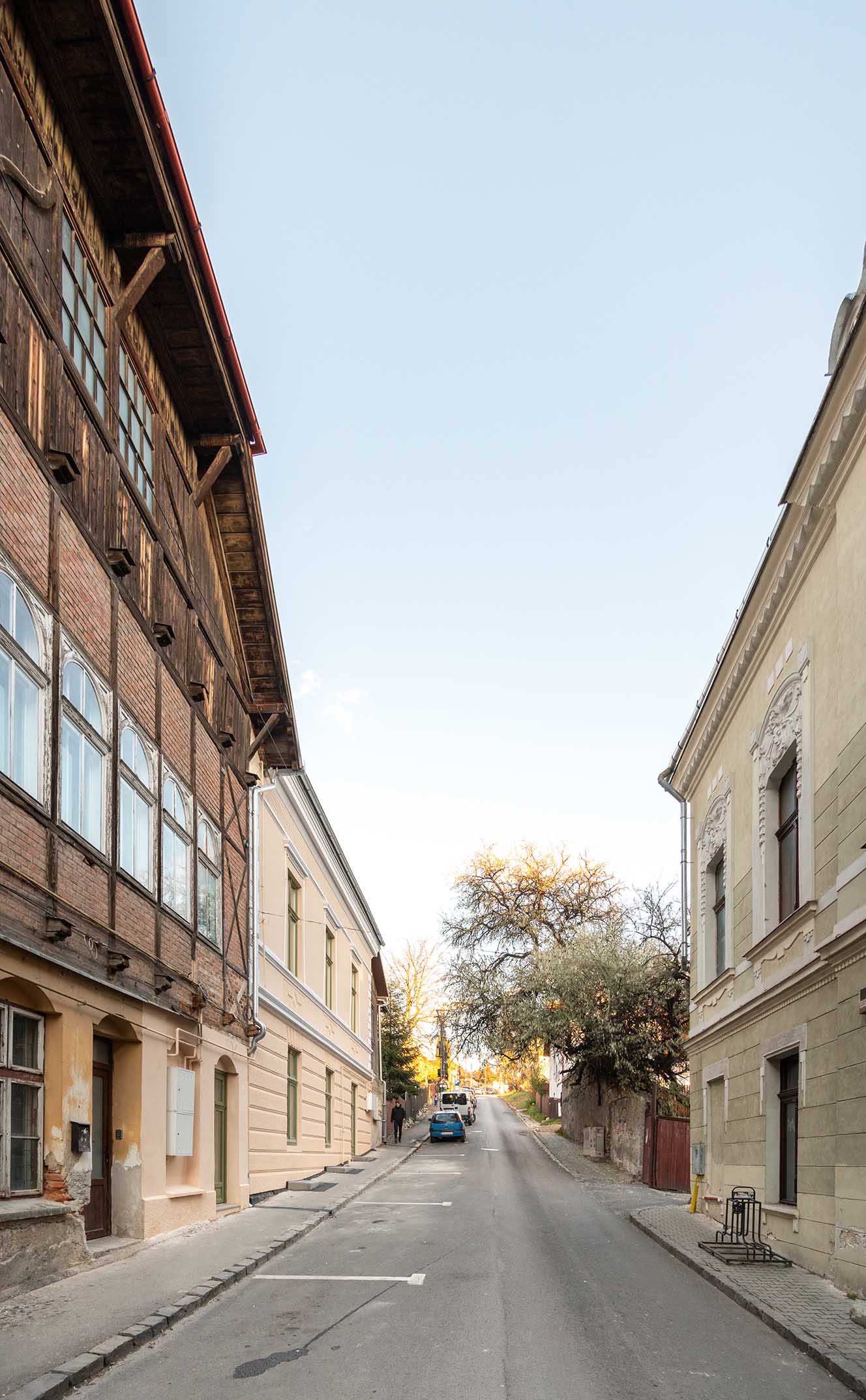
The building in question is part of one of the most valuable ensembles in Miercurea-Ciuc. It is the third building along the street and is an integral part of the ensemble protected as a historic monument under the code HR-II-m-B-12728.
Today, the street is somewhat deteriorated, with the effects of time and various alterations clearly visible on the houses. This makes it especially important to preserve the historical urban fabric and the original atmosphere of the ensemble.
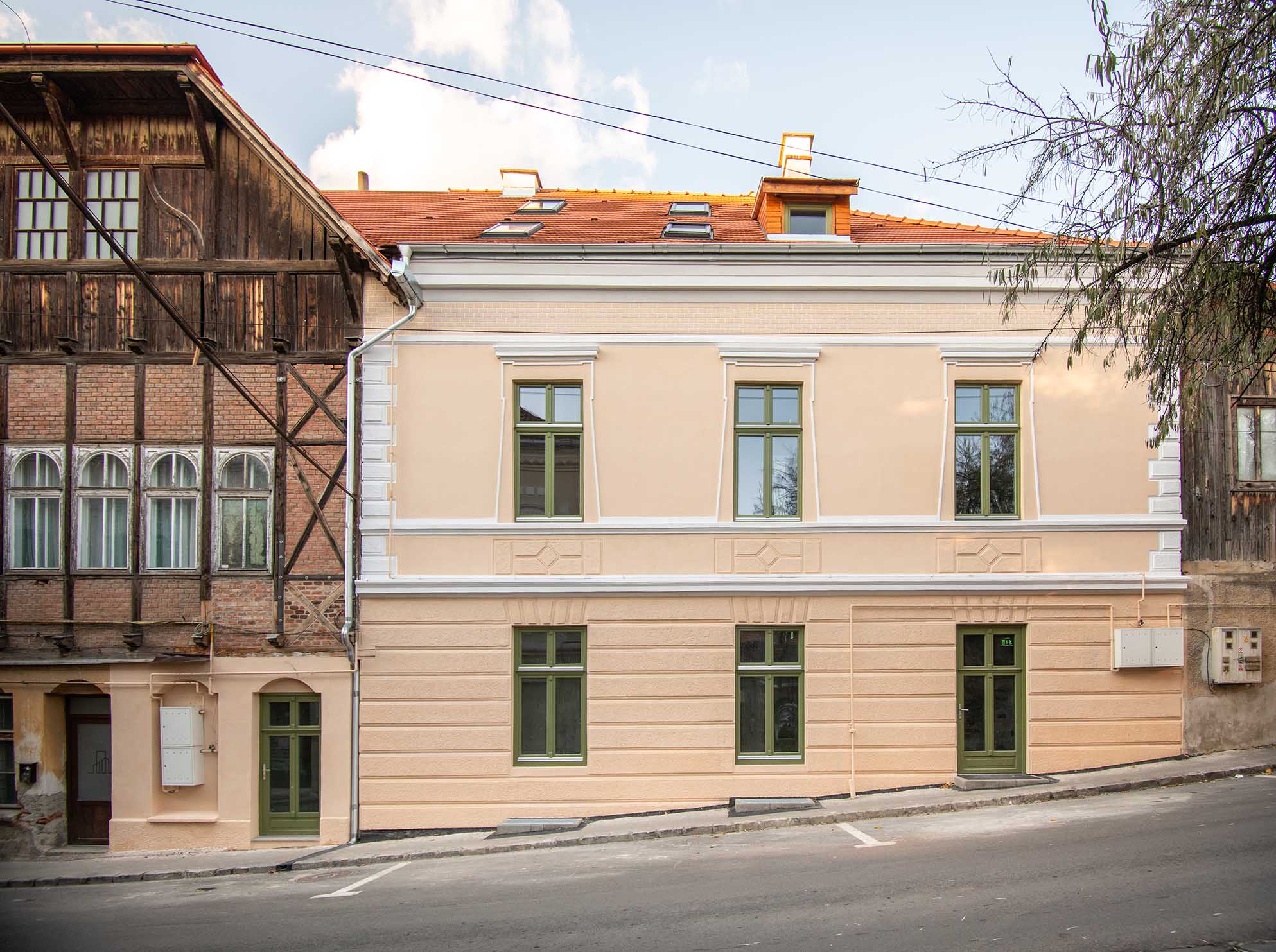
The eclectic style of the building evokes the streetscape of the early 20th century when the city had a very different character. Although its current condition represents a weak point in the street view, its location is prominent, and its architectural values — the era, original elements, spatial organization, and harmonious proportions — remain clearly perceptible.
The plot’s history dates back to the mid-19th century: the first record was made on January 2, 1865, and by 1872 a single-story traditional Székely wooden house was standing on the site, operated by a local merchant, János Leicht.
Over the years, the property had several owners: Mária Michna from 1894, followed by Ferenc Pfeifer and his wife, Matild Michna, and Rudolf Michna and his wife (probably through inheritance).
Around 1902, the new owners constructed two new buildings, each with a cellar, ground floor, upper floor, and attic, with an internal courtyard between them. The courtyard was mainly used for storage, while the corner of the building continued to serve commercial purposes. On the upper floor, a corridor with a porch connected the two buildings.
However, history did not spare the buildings: during World War I, in 1916, retreating enemy partisans or soldiers destroyed and set fire to the roof structure.
At this time, the ensemble took on the form still known today: the internal courtyard was built over, creating a new mass covered by a single roof, complemented in the center by a German-style half-timbered structure, leaving the lower passage open. This passage was only enclosed in the 1990s, making the ground floor fully enclosed and concealing the internal staircase.
Thus, this building is not merely a house: it is a witness to the city’s history, development, and transformations, still capable of telling its story to anyone walking along this street.
Structural Interventions and Concept
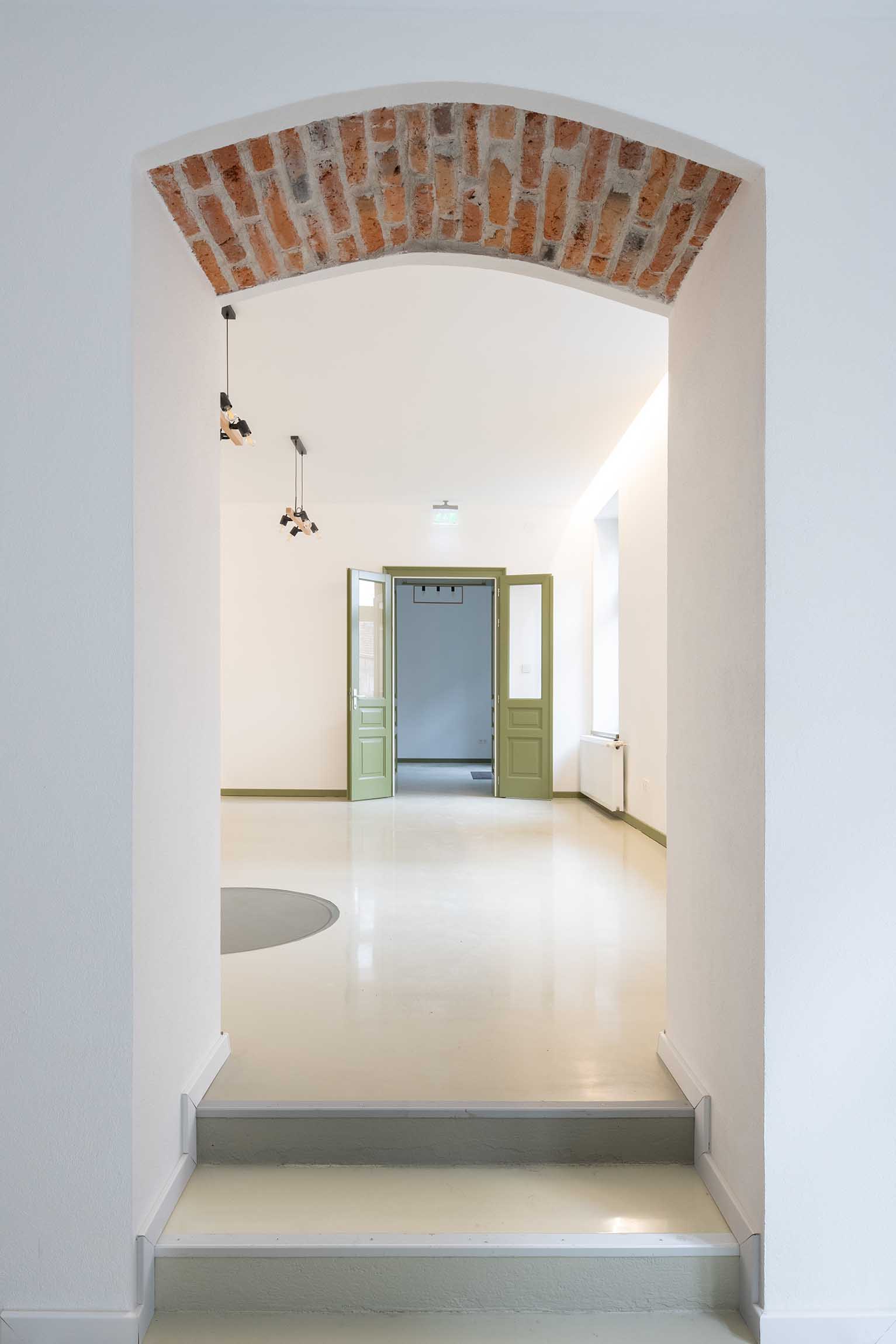
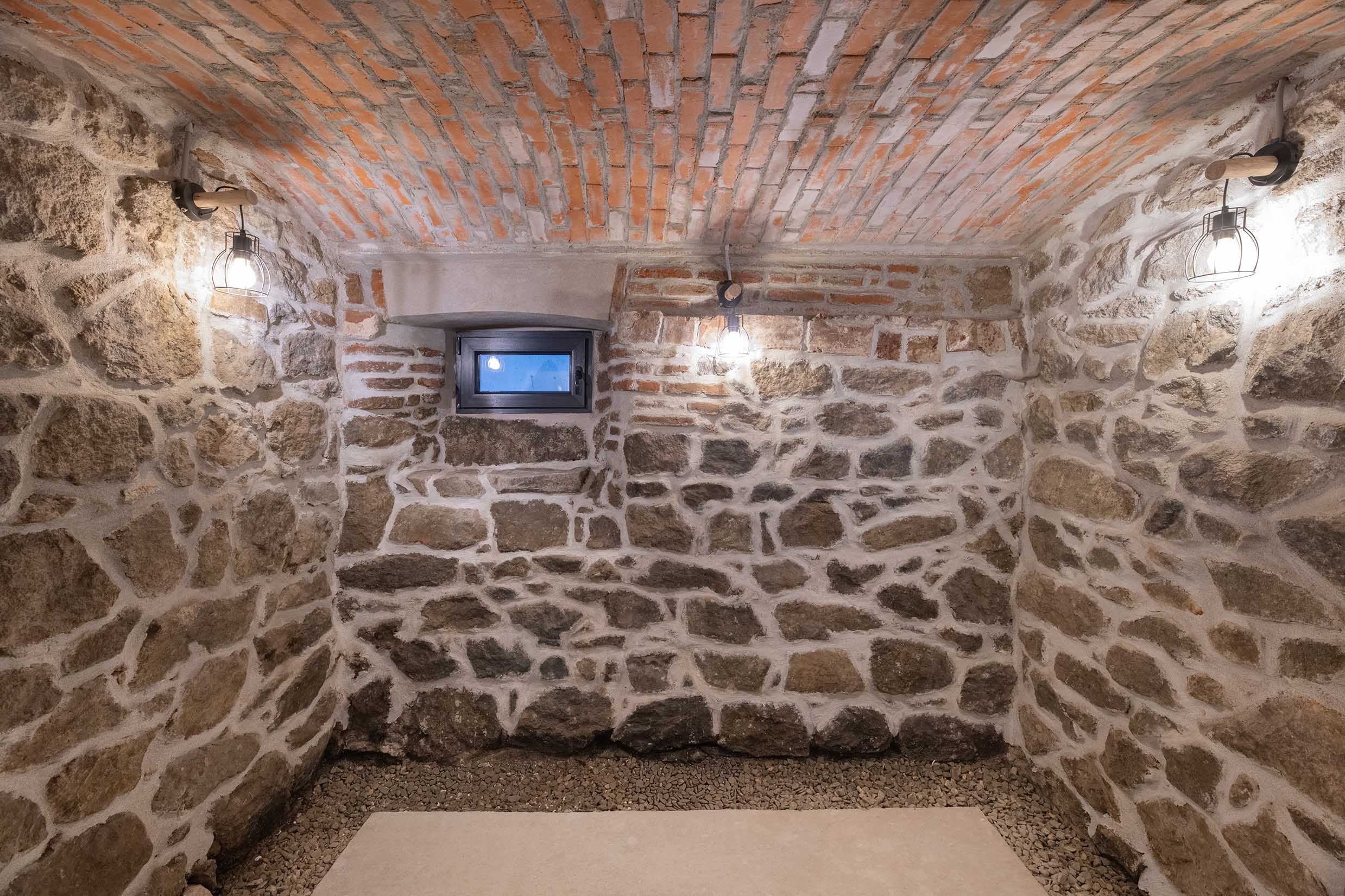
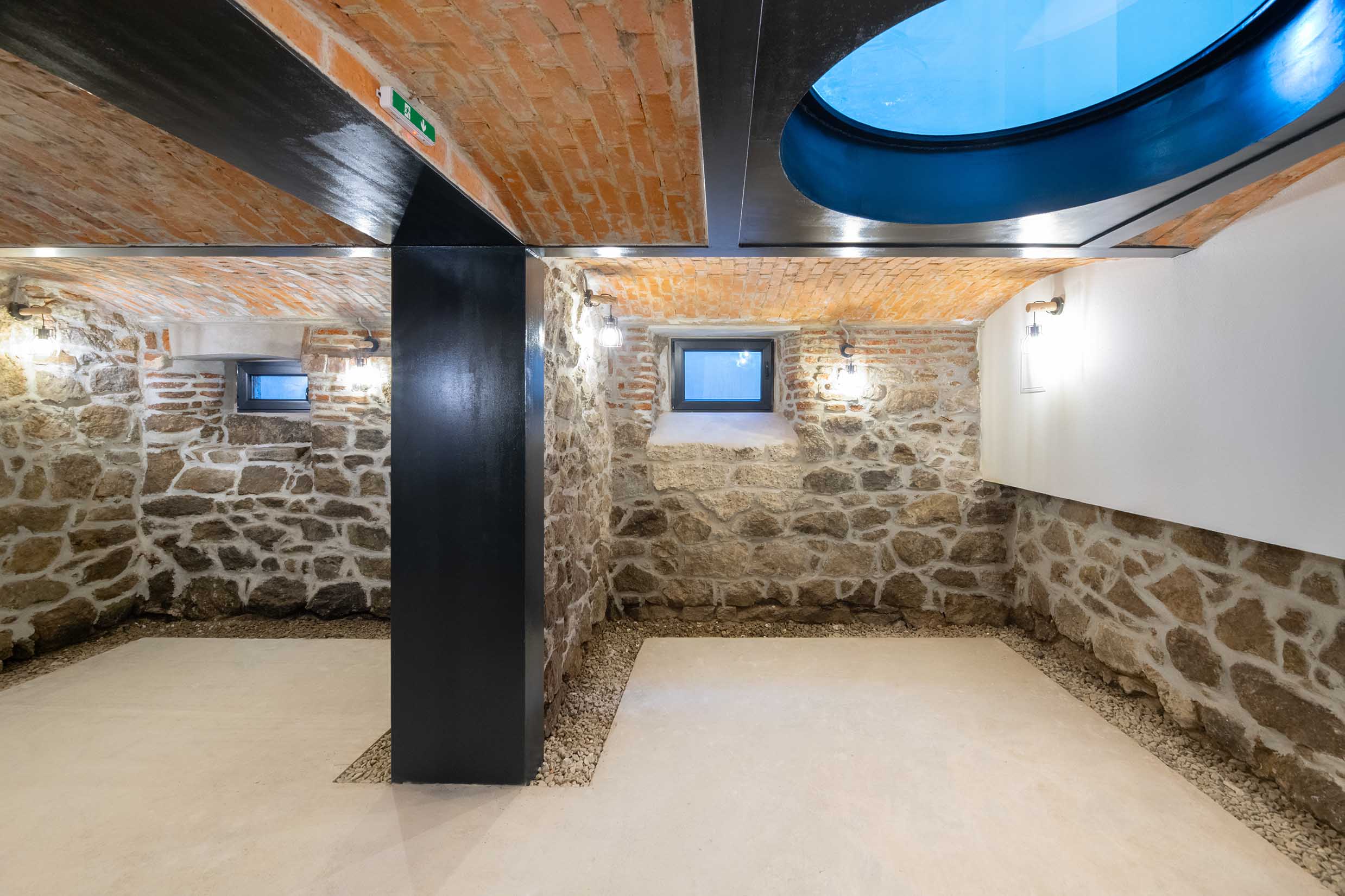
The greatest challenge in planning the restoration was strengthening the structure. The metal beams supporting the Prussian vault between the cellar and ground floor were completely worn and bent, requiring replacement. The entire masonry had to be underpinned, and the passage between the old storage rooms was removed to create a new, usable space with a large, spacious corridor. The cellar’s Prussian vault was raised by 30 cm, and the floor lowered by 30 cm, increasing the headroom from 1.70 m to a usable 2.30 m, complemented by a completely new metal structure and passageway.
The wooden floors on the first floor required reinforcement, achieved with a reinforced concrete slab. The roof structure was deteriorated, with some elements missing or removed. The plaster was crumbling, the main façade was degraded and collapsing, and parasitic elements had been added. The cellar windows were completely damaged.
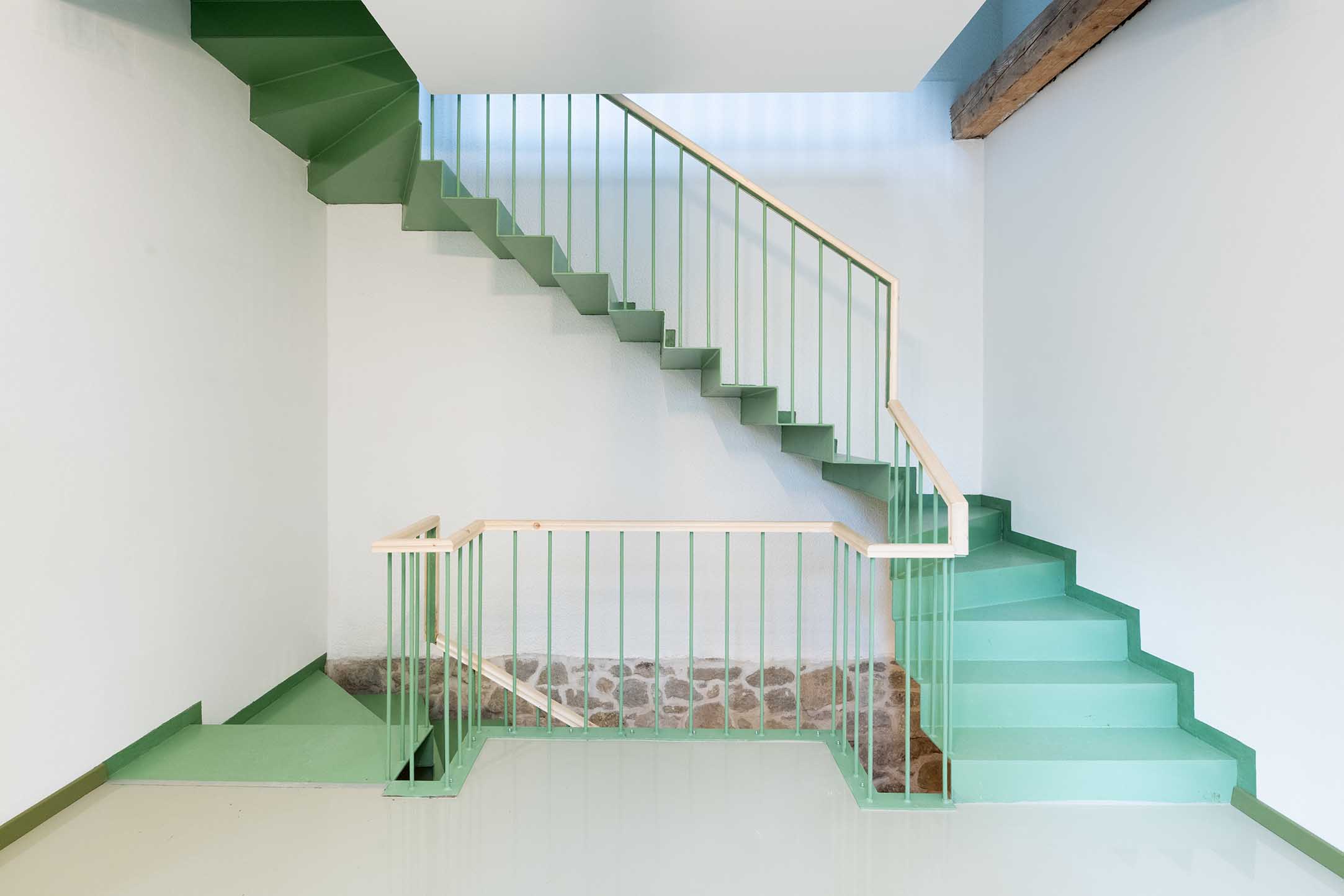
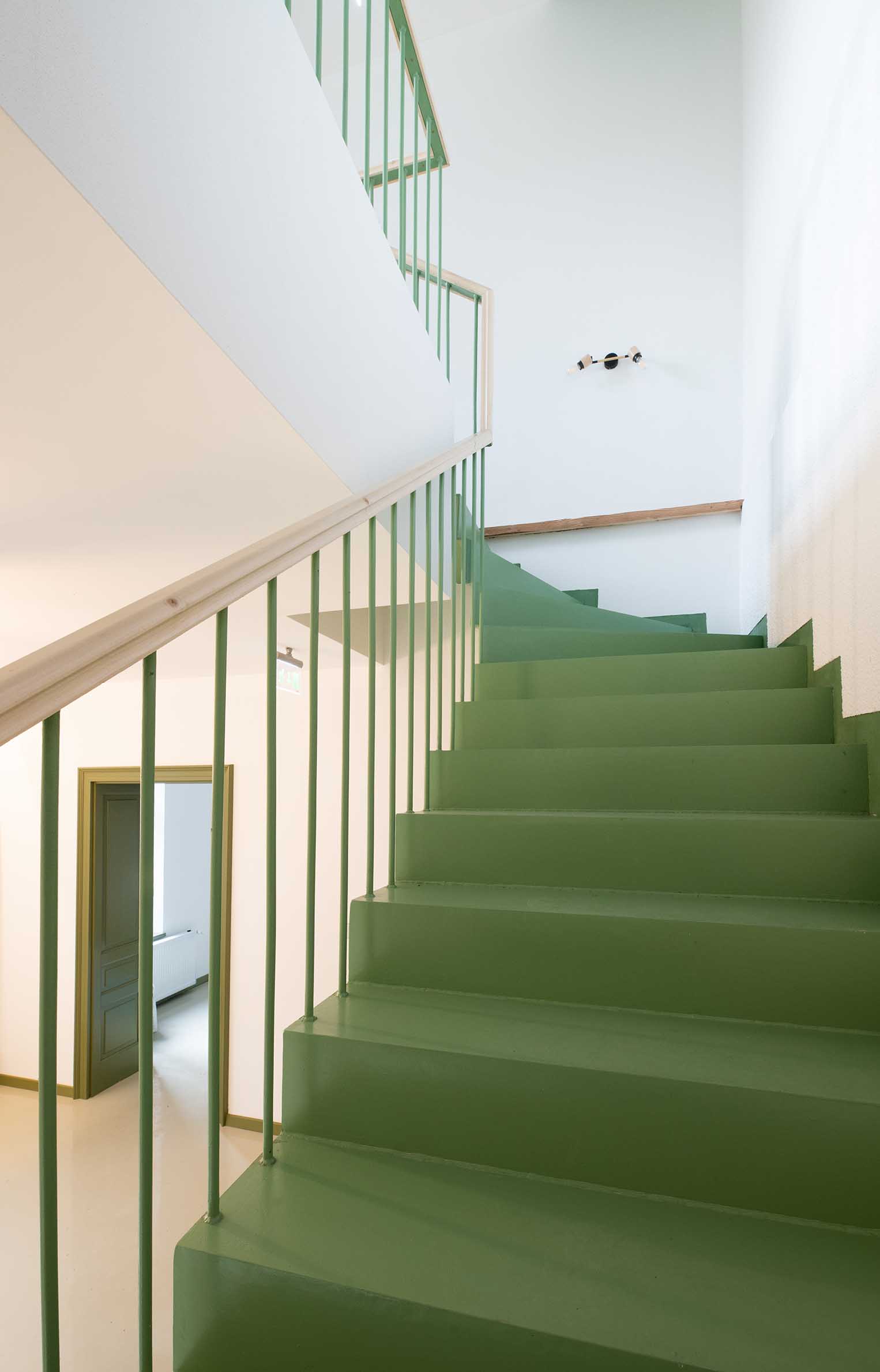
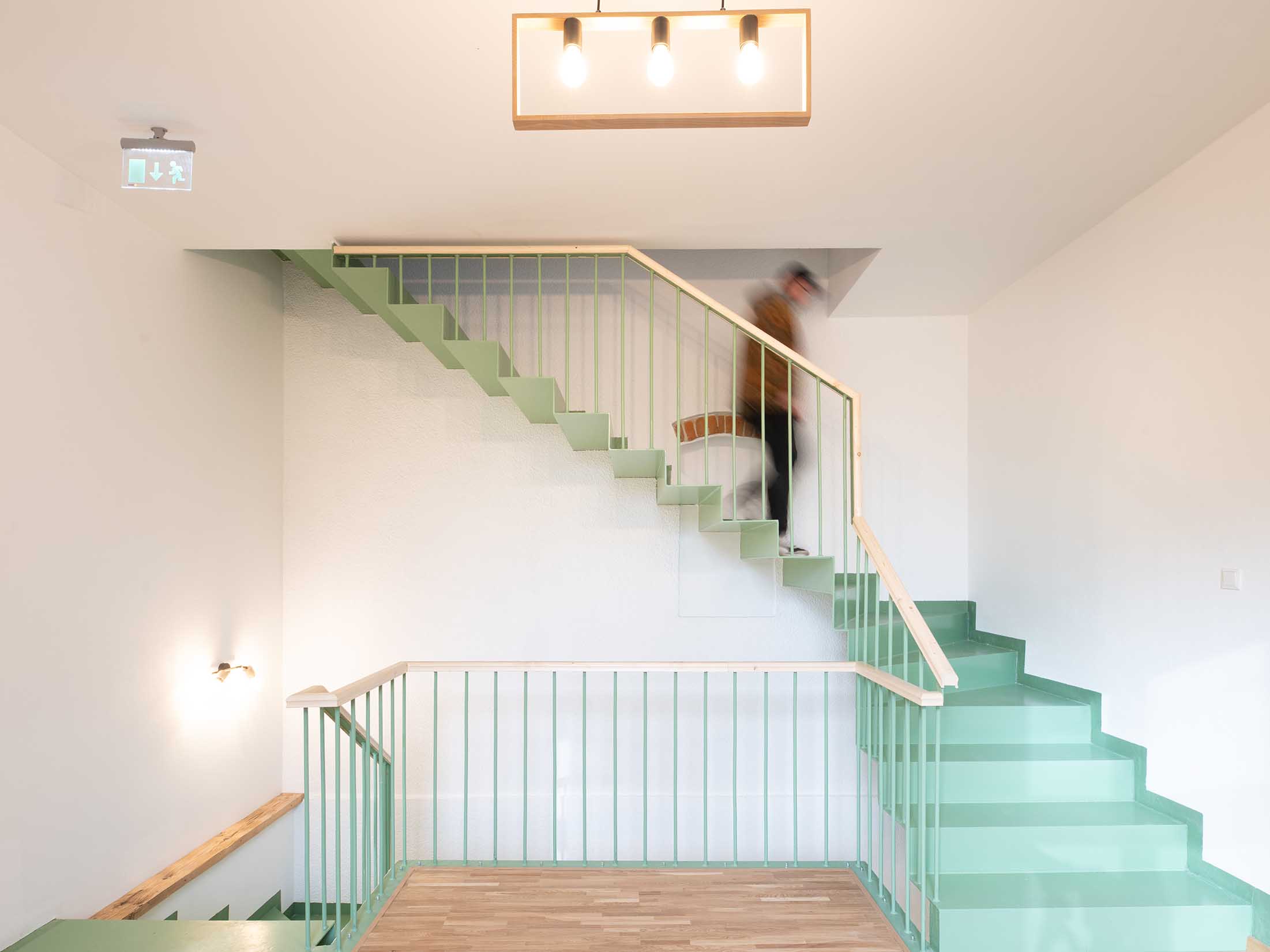
The biggest challenge in design was creating an internal staircase within this structurally damaged building. Previously, there was no internal connection between floors, which could only be accessed from the outside. The concept involved a metal staircase designed as a conscious counterpoint to the historic, fragmented form of the building. The staircase appears as a thin, stylized minimal sheet, winding its way up to the top of the building.
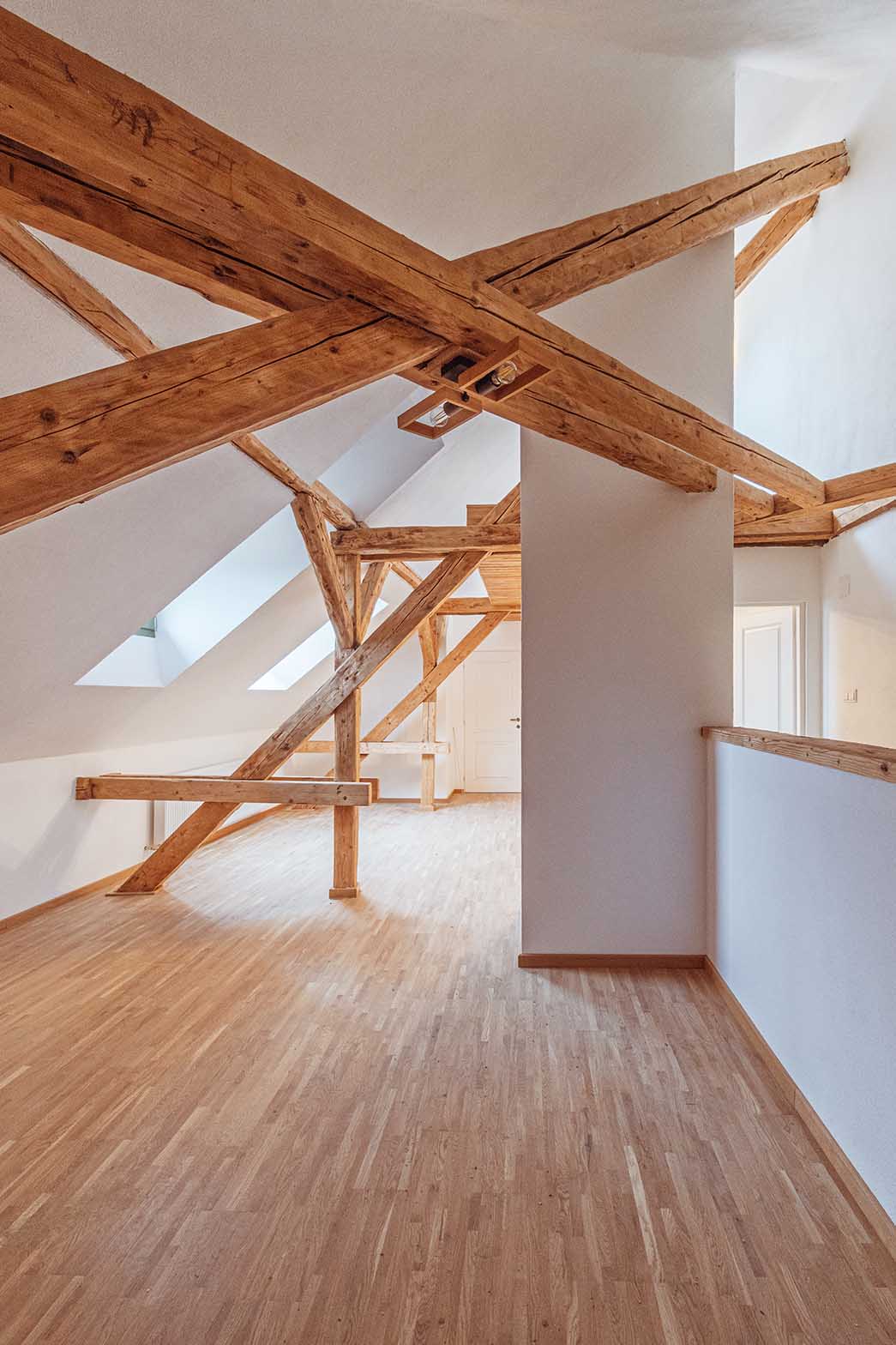
The second priority was utilizing the attic, which had to be fitted between the chords of the classical roof structure.
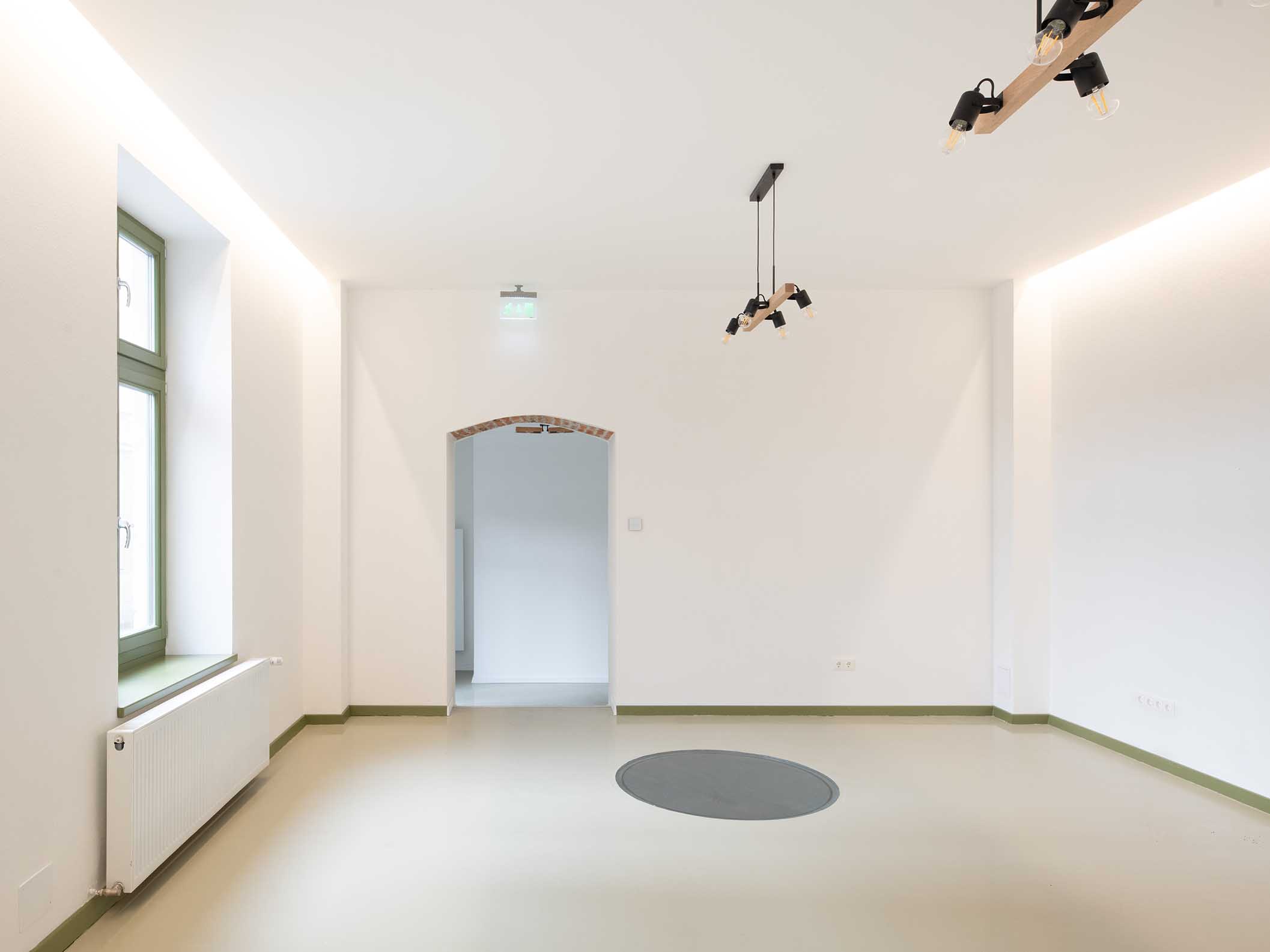
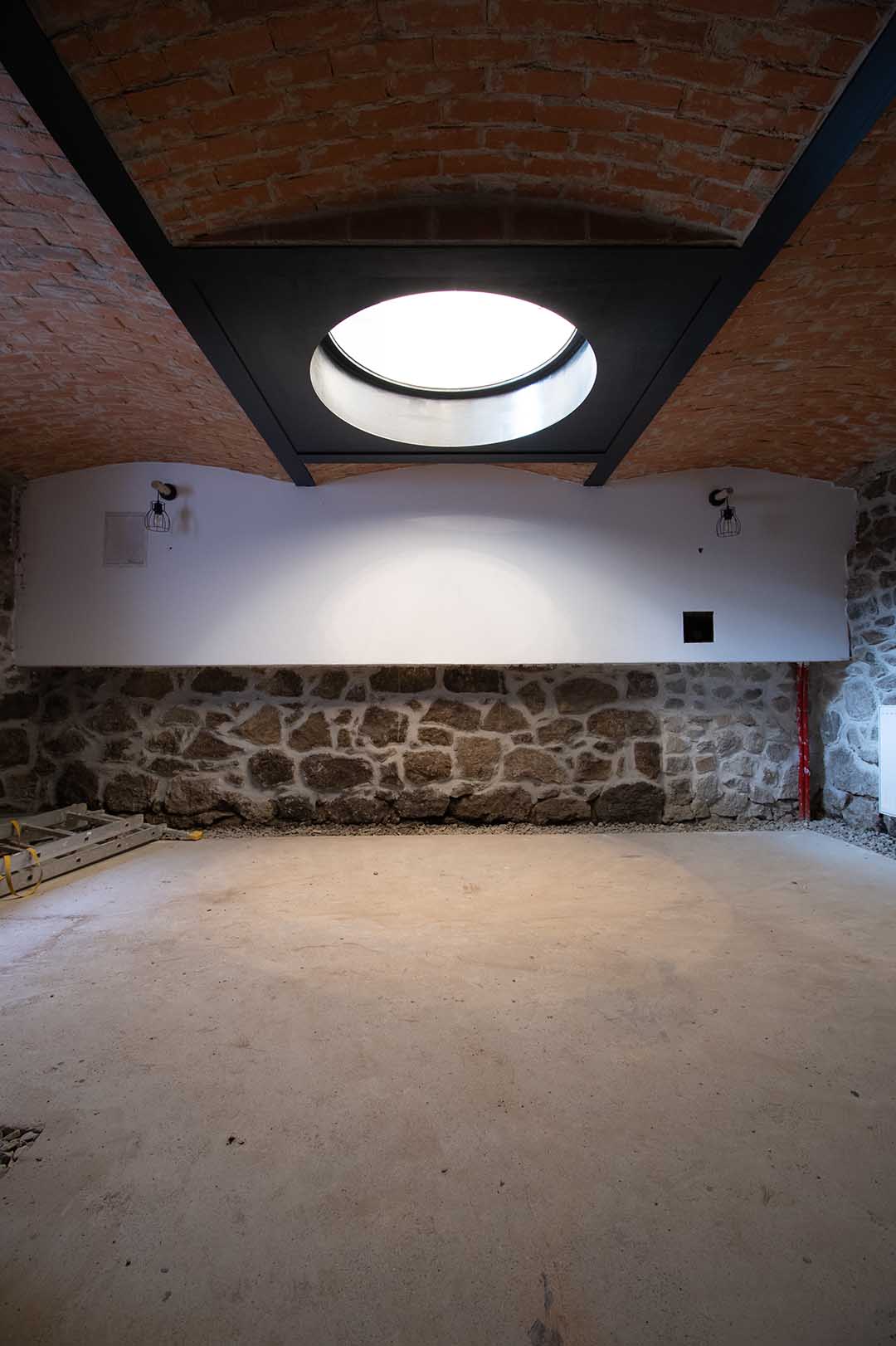
The cellar comprises three sections, with the rear part walled off and inaccessible for years. During the restoration, this space was opened up, highlighted with a circular skylight instead of the previous enclosure. The old blind windows and passages were emphasized, and dramatic light effects were enhanced in places through illumination and the playful texture of the plaster.